This story continues from “Life at the Mill” and describes the mill’s destruction during the Thirty Years’ War — a period in which countless villages, mills, and homesteads perished, often under terrible circumstances. I therefore warn the reader in advance: this is a dark and sorrowful tale.
It was a wretched time, and it had already lasted more than twenty years. A combination of religious, political, and dynastic disputes had brought poverty and the unraveling of ordinary life. Armies flooded across Europe, and wherever they marched, they sowed ruin and death — and the Emperor’s own forces were no exception.
For the Bělice Mill, this meant the loss of its livelihood. The fields lay abandoned, the villages emptied, and there was nothing left to grind. The worst of the fighting had mercifully passed this region by, but news from elsewhere was full of horror and suffering — most of it visited upon the innocent.
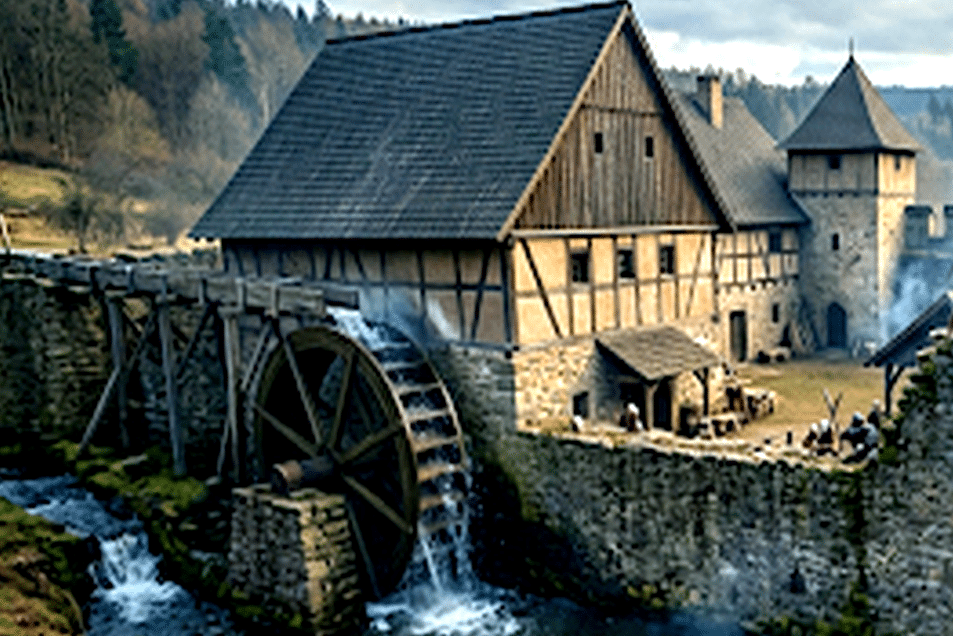
Matouš and Jonáš Bělický, sons of Martin and Helena, had not been idle. They set about fortifying the mill in earnest. The outer windows were bricked up, leaving only narrow slits. The passages between the buildings were sealed with walls two fathoms high, and the gates were replaced with new ones, their hinges reinforced with iron. The mill itself, the barn, the farmhands’ quarters, and the animal sheds thus formed an enclosed whole with a small courtyard at its center — from the outside, it had the appearance of a minor fortress.
The brothers managed the mill together, for their father Martin had not yet decided which of them would ultimately take it over. Also still at home were their sisters Jitka, Johana, and Markýtka, and of the once-sizable mill household, only two farmhands and a serving girl remained. Whether they could hold off an attack with such numbers was uncertain, but they had resolved not to surrender without a fight.
The danger of encountering the enemy drew closer in the year Martin died — peacefully, in his sleep — and a month later Helena followed him, most likely of grief for the husband she had loved.
Jonáš and Jitka were returning from town when, from the hillside above the village, they saw cottages ablaze and heard wild shouting, screaming, and gunfire. It was immediately clear to them that the village was under attack, and they quickly concealed themselves at the edge of the forest.
It was no regular army that had descended on the village. The men wore a jumble of different uniforms, pointed helmets, and carried themselves with crude, brutal force. At that distance not everything was clearly visible, but what they could see was more than enough to horrify.
The Suků farmstead was burning, and two other cottages besides. In the village elder’s yard, the desperate inhabitants were fighting back against the raiders — and losing. One by one they fell under the slashing blows of sabres. The men then threw themselves upon the serving girls who had not managed to hide in time, dragging them toward the hayloft and the barn. The girls struggled and writhed in the arms of their captors, but to no avail. Elsewhere, the bodies of farmers lay in the yard while the attackers carried out their possessions and loaded them onto carts. It was a terrible massacre. Utterly pointless. All of this for the sake of faith?
The siblings had seen enough. They made their way back to the mill by a roundabout route as quickly as they could and told the others what they had witnessed. Everyone prepared for defense. The youngest, Johana, was the most frightened. She was still an innocent girl, and she had heard what happened to young women who fell into the hands of armies gone savage. She pulled Jonáš aside by the sleeve.
“Promise me that if we are about to lose, you will put a bullet through me. I will not fall into their hands alive. Promise me!” Jonáš nodded absently to calm her. He felt a responsibility toward his sister — but whether he would truly be capable of keeping such a promise, he did not know.
The attackers appeared at the mill two days later. First a mounted patrol rode past, and later a force of some thirty men arrived, armed with pistols, muskets, and sabres. They stood irresolute before the fortified yard, plainly uncertain how to proceed.
When they came within range, Matouš brought one of them down with a musket shot. They had several muskets in the mill, and everyone had learned to use them.
The shot startled the rabble enough that they fell back and sent forward a parliamentarian — a man dressed, by his clothes, as a commander, accompanied by another who appeared to be an interpreter, for he spoke Czech. Badly, but well enough to be understood.
Matouš spoke with them from over the wall, refusing to come outside.
“Surrender to us and nossing vill happen to you,” the interpreter called out.
“Why should we? You burn villages and murder the innocent,” Matouš replied.
The man shrugged.
“Zey resisted military authority. You are not permitted to resist. Open ze gate and nossing vill happen to you.”
“We’ve heard that before. Leave us in peace!” Matouš shouted.
The men conferred among themselves and then withdrew with their unit. It was clear they had not gone far — and that they were planning something.
They were. To scale the walls they would need ladders, and to take the gate they would need a cannon. They had both — but not here. The rest of their force was to arrive in a few days; this had been only a reconnaissance party. And even that had sufficed for the plundering of a defenseless village and what they themselves cheerfully called “a little sport” with the village women.
They posted sentries and settled in to wait.
Inside the mill, the waiting was noticed, and morale began to ebb — though not the will to fight. The women, fully aware of what fate awaited them in the hands of a brutalized army, were resolved to fight like lionesses, and they demanded from the men a promise to kill them rather than allow them to be taken. In exchange, they were willing to give themselves to physical desire — without deliberation or hesitation.
Johana was still a maiden, but Markýtka and Jitka had known men before, as had the serving girl Dorka. Matouš, Jonáš, and the farmhands Jíra and Kuba were likewise experienced. Four men to three women. No one suspected that Johana had been quietly forming a plan of her own — to lose her maidenhood before the end came, and that she had chosen for it her dearest brother Jonáš. She had only to work on him at length.
“I will not go to heaven without having known earthly love!” she said with indignation. “As my brother, you ought to help your sister in her hour of need!”
“It is a grave sin. Does that not trouble you?” Jonáš asked, bewildered.
“So? We’re going to die anyway,” Johana muttered resentfully — and then produced her trump card. “And as far as I know, you lost your own innocence with Jitka!”
“That’s a lie! I never entered her… damn it!” Jonáš burst out, catching himself when he had said more than he intended.
Johana knew everything. Nothing stayed secret among sisters. Yes, Jitka had introduced Jonáš to the mysteries of love — but not entirely, though only the proverbial last step had been missing. Actual penetration had never occurred; Jitka had ultimately satisfied him with her hand, and after that nothing more had ever passed between them. It was meant to remain between the two of them — but now that it was out?
And so it came to pass that one night, sharing a watch together, they made love in the hay instead of keeping an eye on their surroundings. Johana had no experience whatsoever, but she was an eager pupil. She grasped the idea of kissing immediately, and everything else followed naturally from there. She opened her legs and surrendered to him the most precious gift an innocent girl can give — her maidenhood.
Despite her plea for gentleness, her brother was not particularly careful. His hard member broke through her innocence with a sharp thrust, and Jonáš clapped his hand over her mouth to muffle the cry of pain. He had to. He did not want to draw things out, and he was already too aroused to stop, while she had begun to writhe and whimper and he feared she might change her mind.
In the girl, the pain slowly gave way to more pleasant sensations, but the finest moment of all was the complete withdrawal and the release onto her belly. Johana knew, even so, that a first encounter rarely brings a woman full satisfaction and pleasure.
The infantry regiment of Colonel Jass Gripenssonhad not joined forces with Captain Saabeneck’s detachment. It had been dispatched elsewhere, but had left behind two field cannons and a force of fifty men under the command of Corporal Volvoberg.
The corporal himself went to survey the situation, and that evening held a command briefing in his tent.
“How do you assess the situation, gentlemen?”
“We have too few men for a fortification of that kind,” the captain said sourly.
“A fortification? Who said anything about a fortification?” the corporal replied with irritation. “It’s an ordinary mill, you fool! Granted, it has been reinforced, and it is likely armed. But is it even worth taking?”
“My men are exhausted,” the captain offered. “We can expect to resupply there before the next march.”
“The attack on the village has taken it out of you, has it? What can I expect from men whose only interests are drink and women,” the corporal said with contempt. “Why didn’t you resupply there? And peacefully, at that?”
“We intended to, but things got out of hand and a few of the lads lost their heads,” the captain admitted reluctantly. “After that there was no stopping it.”
“Hmm,” the corporal said. He could picture it vividly enough. He had heard of the apocalypse that had overtaken Magdeburg years before, and many other towns besides. He had even taken part in something of the kind himself. No — this was no longer a war between Protestants and Catholics. It had become nothing but plunder and the accumulation of spoils.
“I have fifty men and two guns. With yours we’ll be a hundred. Surely that’s enough for the little stronghold. How many can there be inside? Ten?” the corporal said. “I’m closing the briefing. I should like to have my supper now.”
“And afterward, if you will permit — as a dessert, so to speak — I can offer you some enchanting young nuns from the Convent of the Devout Sisters of Christ, or whatever it is called. We occupied it a few days ago,” the captain murmured.
“Saabeneck, you animal!” the corporal bellowed. “How do you express yourself? Am I some kind of cannibal, to be offered a dessert like that?! And nuns, of all things, pushed into my bed! They only squeal, they’re stiff as boards, and there’s no pleasure to be had with them!”
“These are entirely different,” the captain said, shaking his head. “They are compliant, eager — absolutely exquisite, sir.”
“Really? What kind of convent is this?” The corporal raised an eyebrow.
“That is precisely what no one can quite make out,” the captain shrugged. “It is a poor house, but the sisters are — eager, and decidedly not coy. That is why I took the liberty of… for your entertainment… those two…”
“You know what?” the corporal said at last. “Send their abbess to my tent. I should like to hear what manner of order this is. Take the two others to bed yourself. I have no doubt you’ll manage them better than you managed that mill.”
“Mm… oh… that’s nice,” Jonáš murmured, stroking Johana’s hair as she knelt with her head in his lap, concentrating on pleasuring him with her mouth. She was not particularly skilled, but she followed his guidance carefully and seemed on the verge of success. His member was hard and engorged and his breathing was growing faster.
Jonáš, meanwhile, kept watch through the narrow window slit at the approach road, but nothing stirred anywhere. He was therefore free to enjoy what Johana was doing.
“Now… I’m going to… ohh… all of it… ohh… swallow it… yes… yesss,” he groaned, and with powerful surges filled her mouth, while Johana swallowed as best she could.
She licked his softening member clean and ran her tongue across her lips. “Satisfied?”
“Completely,” Jonáš said, and then noticed she was holding him in her hand and working him with rhythmic strokes. “What are you doing?”
“Perhaps I’d like to be satisfied too, dear brother,” she smiled, coaxing his soft member back into a firm, resilient state.
The moment she succeeded, she pulled up her skirt and settled herself into his lap. He slid into her smoothly, all the way to the root.
“Aaah,” she breathed with pleasure. “Touch my breasts,” she offered, opening her blouse to him.
And so Johana rode him, while Jonáš devoted his full attention to her firm little breasts.
When he felt he was close, he pulled her down onto all fours and took her from behind. Hard and deep.
“Oh… you’re… rough,” Johana yelped — but in the next moment dissolved into sighs over the rhythmic thrusts, the slap of their bodies growing faster and faster, until he withdrew and his release arched across the curves of her behind and her back.
Johana had wanted to feel it inside her, but she understood that with Jonáš she simply could not risk becoming with child. What they were doing already displeased God enough — why provoke Him further.
The other pairs in the mill were coupling in much the same manner, taking equal care against the risk of pregnancy. The times were hard and no one knew what lay ahead. But instead of lovemaking, everyone was now principally occupied with the shelter of last resort.
At the back of the cellar, behind the drive shaft mechanism and a heap of odds and ends, Matouš had discovered a hollow space cut into the bedrock. It had perhaps once served as a small cellar; now it would serve as a hiding place. The brothers cleared it out, widened it as much as they could, then sealed it with a wall of loosely fitted stones and stacked the old junk in front of it again. This was the refuge of last resort. The chances of anyone finding it were nearly zero — in a dark, damp cellar, behind the shaft and the tangle of the mill mechanism, tucked into the furthest corner. Who would look there? They laid in some provisions, enough that they might survive there for a time.
Abbess Kleciána stepped before the corporal with a defiant expression.
“My name is Erik Volvoberg, Reverend Sister,” the corporal addressed her — in Czech, which visibly astonished her. “And I assure you at the outset that you are not a prisoner or anything of the sort. I merely wish to speak with you.” He gestured toward the table, where wine stood alongside a platter of sliced meat and flatbread. “Eat, drink, and talk,” he invited her, helping himself to some meat. The abbess needed no further encouragement and fell upon the food with evident hunger.
“What do you vant to know, sir… sir… Volvergu?” she said between mouthfuls.
“Volvoberg,” the corporal corrected her with a smile. “Call me Erik, Luciána.”
The abbess went rigid as though struck by lightning. She stared at the man intently. She did not recognize him. After so many years and so many clients, that was hardly possible.
“You are mistaken, sir. I am Kleciána,” she composed herself.
The man smiled.
“And what about Bivoj? The doorman of that Paradise Garden of yours? He was my brother. He used to let me in secretly so I could watch through the holes in the wall and see what went on in there.”
“How revolting,” Kleciána said, her expression darkening.
“You were magnificent back then. Even now your ripened beauty has not left you. I went out into the world, and here you see what I have become — Swedish Corporal Erik Volvoberg, alias Emil Volejník.”
“Yes. Bivoj’s surname was Volejník, but I never knew he had a brother. Why would that have concerned me? I had other things to worry about — how not to get with child, how to defend myself against a violent client… Did you and I ever actually — together — ?” The woman stopped pretending about her past.
“No. We did not. A certain Kateřina relieved me of my innocence for half a florin, but that was all I ever had at the Paradise Garden. Father Olbram and the monks from St. Zich’s kept a close watch, and I was a poor young man and therefore an unpromising client. They would have been done with me quickly — and I couldn’t risk getting my brother into trouble,” Erik replied.
“What do you actually want from me? To remind me of my past? I am happy to forget it again. I am now the abbess of a convent—” Kleciána began to bristle.
“In fact, I wanted to speak about the convent and the chastity of devout nuns — but as I see it, I already have my answer,” Erik smiled.
Kleciána poured herself a cup of wine and drank it down in one before speaking.
“You know nothing. But very well — listen, soldier. Each of us carries her own cross. Some lived as concubines; some lay with their own brother, father, or uncle; some were seduced and dishonored by a passing stranger — a soldier, a peasant, a vagabond. In the enclosed life of a convent, we try to forget all of it and smother that sinful past with piety and purity of spirit. Only — it cannot be done. Temptation and the fruits of sin are ever-present, and for some of us still alluring. And so we live the convent life, but we do not deny ourselves the pleasures of the flesh — the carnal kind, I mean. When your soldiers attacked us, what were we to do? Resist? To what end? We would have been violated by force regardless. We chose the path of sin, but at least a peaceful one — and for some, even a pleasurable one. Now you know.”
“It is not women I am interested in so much as gold. Where have you hidden your valuables?” Erik’s tone sharpened.
The abbess laughed. “Where would we have gotten any? The sisters gave all their worldly possessions to the convent upon entering, but what do you expect from fallen women? Gold and jewels? We live on the tithe from the village and whatever alms people see fit to give us. We are utterly penniless.”
Erik eventually accepted this, though he had harbored doubts at first.
“May I go?” The woman rose to leave.
“Of course… wait, let me open the door for you,” Erik said courteously, reaching for the handle — and at that moment their faces drew close enough that each saw in the other’s eyes the unmistakable glint of desire. There was nothing else it could have led to but an embrace and a passionate kiss.
The pair then moved to the bed concealed behind a screen, where they gave themselves over to each other entirely. Kleciána showed Erik the art of Luciána, and though the corporal had been a guest in brothels across Europe, he felt for perhaps the first time in his life something approaching extraordinary pleasure. Her mastery of touch and caress was unmatched. She also knew how to tease and delay the peak for a prolonged time — drawing him close to the edge, then pulling back, so that he would not finish before she was ready. She brought him to his release with her hand, and the moment she had coaxed the last drop from him, she threw herself upon him, kissing him, biting softly at his neck, whispering that she wanted him to please her in return. In short, she worked him into a state where he was eager to caress, kiss, and explore her full, firm breasts — and then she drew him onto her, and he entered her as easily as a knife slides into butter.
The man had little imagination, and the straightforward position suited him fine. After a time of steady, mechanical thrusts, he finished, spent himself inside her, and that was that. Kleciána did not even try to steer things for her own satisfaction.
It would have been pointless. With soldiers it is always quick. And usually equally unsatisfying.
The assault on the mill began at dawn.
A volley from dozens of muskets was intended as a distraction — to draw the defenders into responding and reveal how many were inside. It succeeded at neither.
Jonáš was dozing with Johana beside him in the hayloft. Matouš and Dorka were asleep in the house, and the remaining four — rather than keeping watch at the gate — had been engaged in far more intimate pursuits. The gunfire caught them in a compromising position: Jíra and Kuba were driving into the kneeling girls from behind, their skirts hitched up. This was the plain truth. Without a trace of embarrassment, all four were coupling side by side — and, it had to be said, had even been swapping partners. Jitka and Markýtka were the closest of all the siblings. Having decided to share the men in the mill, why not explore each other as well? Their mother and father had sometimes been affectionate quite openly and had scandalized no one. They understood Johana and Jonáš’s sinful arrangement; they had no need to witness Matouš with Dorka — but between themselves, they kept no secrets.
At the thunderclap of the first shots, everyone startled. The girls pulled down their skirts, the men tucked themselves in, and all hurried to their prearranged positions.
The attackers came at a run from three directions at once, ladders in hand and with a wild battle cry, while two field cannons were trained on the gate. As it turned out, the small bore could not blow the gate apart with a single shot, and in any case Matouš managed to wound the cannoneer with his musket, forcing the guns to be repositioned.
The first attackers to scale the walls were killed by the defenders, but there were far too many of them, and Matouš gave the order to fall back to the house. Jonáš looked frantically for Johana, saw her seized by a soldier, killed the man, but then both of them realized there was no longer any way into the house. The yard was filling with attackers, and they made a dash for the hayloft. On the way, Jonáš caught sight of a soldier seizing Dorka as she screamed and fought back — and then a shot rang out from the house, and the girl crumpled to the ground. Someone had granted her the last mercy. They would come to the same end. They shut themselves into the hayloft, and Johana kissed him through her tears, whispering that she loved him. From the gate came the sound of men forcing their way through, and there was little time left. They kissed one final time and walked out onto the threshing floor together. There they held each other, Johana closed her eyes, and Jonáš drove his dagger beneath her ribs with a single swift thrust. He laid her gently on the ground, crossed to the gate, and opened it himself to the attackers. He fell immediately under a flurry of blade strikes, and the men poured in, searching for the girl. When they found her dead, a savage fury overtook them. All of it for nothing.
Once inside the mill, there was no trace of the remaining defenders. They searched the entire building — nothing. No people, no valuables, no food.
Corporal Volvoberg spat on the ground. “They slipped out by the water. The banks are thick with reeds and grass. Why were there no sentries posted there?! After all these years of campaigning, you’ve learned nothing! There’ll be no drink, no women, and certainly nothing worth having in this godforsaken hole! The whole thing was a waste. Burn it and we move out.”
Outside he was told that five of his men had fallen. Against three dead defenders — two of them women — it left him speechless. The entire skirmish had been utterly pointless.
A handful of men remained behind to burn the mill thoroughly to the ground. By the time they left the still-smoldering ruin, nothing stood but the stone walls, the occasional blackened beam, and in the stream, the broken fragments of the waterwheel.
EPILOGUE
In 1976, an archaeological survey was carried out on the site. Nothing extensive — the mill held no particular historical significance. It was more a matter of documenting formerly inhabited places that had never been resettled.
The ruins had long since surrendered to time, and what remained had been covered over by merciful nature. The millrace had silted up and even the course of the little river Smrdava had partially shifted.
Before the survey itself could begin, a group of university students from the Faculty of Arts was sent to clear the site of overgrowth and accumulated soil — a back-breaking task. Mud, stench, mosquitoes.
One afternoon, four of them remained at the site: Dana, Klára, Honza, and Leo — a classmate from a friendly foreign country, specifically Zambia. His real name was something else entirely, but it was so impossible to pronounce in Czech that everyone — professors included — called him Leo, which suited him perfectly well.
“I’m going back to camp to start dinner,” Klára announced, and Leo rose with her.
“We’ll come too, won’t we?” said Honza, but Dana shot him a look.
“Quiet. Can’t you see they want a bit of time to themselves?” she added under her breath, silently cursing how completely oblivious he could be. It had been obvious for days that something was sparking between Klára and Leo.
Now it would properly catch fire. Good for them. Klára had always been the wilder one, someone who enjoyed experimenting. She tested men — or rather, what they had to offer — and then held court on the subject back at the dormitory. Asian men were on the small side, she would report; European and Arab men varied considerably; and Black men were sometimes so generously proportioned that she feared they might split her in two. She described it all in such detail that her listeners’ eyes would go wide. Group encounters held no terrors for her; swallowing was no obstacle. She was, simply put, an adventure.
Dana considered herself more restrained, and she would have been perfectly happy with Honza — but the man couldn’t pick up even the clearest signals, and she wasn’t going to keep throwing herself at him. It was a man’s job to pursue a woman.
And so while Klára and Leo went off to enjoy themselves, Dana was left scooping mud into buckets.
“Aaah—” something snapped beneath her without warning, the ground gave way, and she plunged straight down into the depths.
Honza was at her side a second later. “Dana — are you alive?”
“Yes. I’ve banged my leg, but I’m fine. I seem to be in some kind of cellar. Grab a torch and come down,” came the voice from below.
Before long, both of them had established that they were standing in the mill’s cellar. There had evidently once been a vaulted ceiling; it had long since collapsed, and the earth and vegetation above it had formed a kind of solid crust — one which had not been able to bear a person’s weight, hence Dana’s descent.
Now they stood on firm ground and stared at the crumbled remains of the milling machinery. The drive shaft from the waterwheel was remarkably well preserved, but everything else was either rotted, fallen apart, or charred — evidence of what must have been a considerable fire. The cellar ended in a wall of stone blocks. On closer inspection, one stone in the corner appeared to be slightly displaced. It caught their attention. Honza held the torch while Dana tried to move the stone. It shifted. The stone came free, and behind the wall another space opened up — though the gap was too small to even get one’s head through. Several more stones around it would need to be removed.
Leo, flushed and braced on his arms, lay over Klára, who writhed beneath him with consuming pleasure as he drove into her with steady, powerful strokes. He, too, was among the well-endowed and therefore well-regarded members of the student body — most of them with darker complexions. Leo had a solid twenty centimeters when fully roused, correspondingly thick, and for many of the girls it had been something of a revelation.
Full oral satisfaction was beyond most of them, but a willing body has a way of accommodating even such dimensions. The intense friction and the sense of being completely filled lifted them to dizzying heights of pleasure. As it was lifting Klára now.
She had managed only a brief taste of him before he was already spreading his legs apart so she could pull him in. And Leo never needed much encouragement. He was accustomed to female interest, moved from one willing girl to the next, and knew perfectly well that the supply of eager company for the duration of his studies would not dry up. As a crowning touch, he was also sleeping with a certain professor — a forty-five-year-old divorced mathematician named Paní Dáša — which ensured him a consistent top mark in her subject. He often came for consultations, usually as the last student of the day, and afterwards the professor would emerge looking somewhat “rumpled” and walk home with a slightly uneven gait. But that is beside the point. Right now he was occupied with Klára, who was thoroughly enjoying herself as he drove into her and worked her firm breasts in his large hands.
She cried out like a siren when she came, and he filled her with a copious flood of semen. It was rough and wild, and Klára was perfectly satisfied — as was Leo — when Dana and Honza came sprinting up, wide-eyed, to announce their discovery.
The two flanking stones were also loose, and once removed, the opening was large enough to squeeze through.
“I’ll go first,” said Honza bravely, though inwardly frightened. Dana said nothing — she felt exactly the same.
Honza had pushed himself halfway through when he suddenly cried out in shock and scrambled hastily back.
“There are — there are — some kind of skeletons in there!” he sputtered.
“Wonderful!” Dana exclaimed with delight. At last, a real find — though she showed no great eagerness to explore it personally.
“That’s where I stop. I’m going back to camp!” Honza said firmly, and the two of them set off to report their discovery to the others.
A detailed anthropological examination of the skeletal remains told a sorrowful story of the fates of those found within — two women and three men. Beyond any reasonable doubt, sometime around the middle of the seventeenth century, a large and devastating fire had broken out in the building above. The individuals in question, for reasons unknown, had not escaped to the outside, but had instead sought shelter in the cellar, where they were spared from the flames but not from the smoke. They had suffocated. The bodies showed no signs of injury, and the provisions that had been stored there remained untouched. The archaeological survey yielded no further discoveries of note.